Doctrine
A picture is a thousand words — in any language.
Dingfelder Field Handbook™ Visual Companion
A drawing-rich mechanical idea library for understanding how motion, force, timing, holding, release, adjustment, stored energy, guided motion, and machine function are created.
Terminology Panel
Use these quick links when a term needs a plain-language definition, then return to this section without losing your place.
Connected system
The Sourcebook is the visual lane. Use it with the Handbook, Methodology, and Field Calculators so a mechanism drawing becomes a practical path from motion to diagnosis to improvement.
Doctrine
A picture is a thousand words — in any language.
Inventor Heritage
The Sourcebook carries forward a Dingfelder family tradition of invention, practical engineering, field problem-solving, and original patent drawing work. Its patent-plate visual language is intentional: clean, functional, disciplined, and built to explain how a device works.
Rooted in Dingfelder inventor heritage. Built with original explanations, original drawings, proper credit, and respect for prior art.
Why this exists
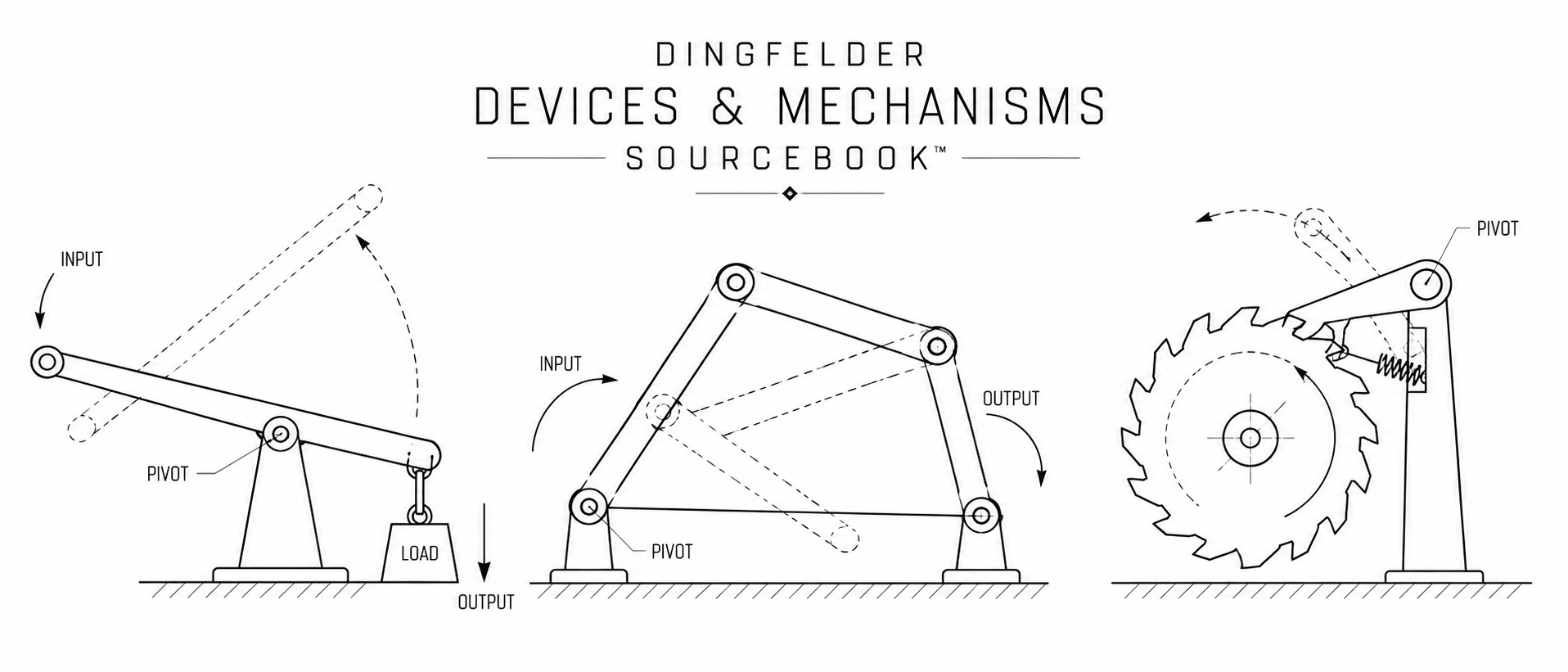
A mechanism is not only a part. It is a relationship between parts. A lever depends on a pivot. A linkage depends on every pin. A ratchet depends on the tooth holding the load and the pawl sitting in it. An indexer depends on dwell. A feed depends on controlling the first part in line. A guide determines whether power becomes useful motion.
The Sourcebook helps people see what moves, where it pivots, where it slides, where it locks, where it releases, where it stores energy, where it wears, where it pinches, where the load goes, and where failure begins.
Sourcebook mechanism families
The Sourcebook now includes twenty-one foundational mechanism families, moving from levers and linkages into reciprocating motion, clamping, timing, indexing, holding/release, feed control, adjustment, stored energy, and guided motion.
Rigid members that move around pivots to multiply force, change direction, increase travel, or trigger other mechanisms.
If it pivots, the pin matters.
LinkagesConnected link systems that create controlled motion paths from simple rotary or rocking input.
Four bars only behave if all four are telling the truth.
Holding & IndexingOne-way and step-motion mechanisms that hold, index, advance, or block reverse movement.
If either one is worn, do not trust the click.
Motion ConversionRotary-to-linear mechanisms that drive sliders, rams, yokes, pumps, feeders, shuttles, and reciprocating machine motion.
The load travels through the pin, rod, guide, and frame.
Clamping & LockingOver-center mechanisms that multiply force, clamp, lock, release, or snap between positions.
Small hand force can become big machine force.
Timing & FollowersShaped mechanical timing devices that create lift, dwell, return, release, and repeated follower motion.
If the follower loses contact, the promise is gone.
Indexing & DwellIntermittent indexers that convert continuous rotation into step-by-step motion with dwell periods.
A polite shove followed by a forced wait.
Holding & ReleasePosition-holding and release devices that locate, retain, capture, or release machine parts and gates.
Usually holds is not good enough.
Feed ControlMechanisms that separate, meter, stop, release, index, or feed one item or one step at a time.
Control the first part in line.
Adjustment & PositioningSimple adjustment mechanisms that move, clamp, level, tension, align, or position machine parts with screws, wedges, shims, eccentrics, and turnbuckles.
If you keep adjusting it, something else is moving.
Stored EnergySprings and counterbalance devices that return, hold, assist, absorb shock, snap through positions, or store energy for later release.
Stored energy is waiting for permission to move.
Guided MotionGuides, slides, stops, locating pins, nests, and positioning devices that control where a part moves and where it stops.
Guides make it move where it is supposed to.
Torque ControlMechanisms that connect, disconnect, slow, stop, hold, slip, or transfer torque through friction, jaws, one-way elements, bands, discs, and combined assemblies.
One is losing hold, the other is losing control.
Power TransferGears, belts, chains, pulleys, and sprockets that transfer motion and power while changing speed, torque, direction, timing, and shaft relationship.
Turn the right thing, the right way, at the right speed.
Rotary TransferStation-to-station rotary mechanisms that index parts, fixtures, tooling, and process stations through repeated dwell-and-index machine cycles.
Every station gets its turn in the right place.
Transfer & HandoffMechanisms that push, lift, slide, shuttle, pick, place, carry, or hand off parts and product between stations.
Moving it straight and on time is where the machine tells the truth.
Clamping & FixturingClamping concepts that hold parts, tooling, guards, fixtures, or assemblies using screws, toggles, wedges, eccentrics, springs, cams, or fluid power.
A clamp should hold the work, not fight the mistake.
Production Machine PlatesCommon packaging and production machine mechanism concepts: gates, guides, feeders, transfers, reject devices, star wheels, sensors, wear points, and timing.
A production machine is a conversation between mechanisms.
System-Level Machine ThinkingSystem-level machine-building plates connecting parts, assemblies, mechanisms, stations, machines, systems, controls, safety, access, and simplification.
A thousand simple truths forced to agree.
Fixtures & WorkholdingFixture and workholding concepts that locate, support, clamp, release, and repeatably present parts for real work.
The locator is the boss.
Guarding & AccessGuarding and access mechanisms that protect people while allowing practical inspection, service, cleaning, and repair.
A removed guard is a design problem wearing a safety label.
Need a calculation?
For load path awareness, lever torque, hydraulic or pneumatic force, analog scaling, VFD speed, power transfer, and electrical loading, move from the mechanism page into the calculator lane.
Need a troubleshooting path?
When the mechanism behaves differently than the drawing, go to the live issue, protect the truth window, and prove what actually happened before changing the machine.
Expansion path
After this v7 expansion, the Sourcebook now includes twenty-one mechanism families and can continue toward field-adjustment examples, machine-safety interface plates, and deeper Machine That Builds the Machine case studies.
Drawing Standard
Sourcebook drawings should feel like clean patent plates, but they should be original Dingfelder drawings — not copied patent drawings. The goal is not decoration. The goal is understanding.
Patent & Prior Art
Many mechanism families are ancient or long-established. When patents, historical references, manufacturer examples, standards, or technical sources inform a page, they should be credited and linked when practical.
Final Sourcebook drawings should remain original Dingfelder drawings unless public-domain status and source credit are clear.
Make these checks prior to proceeding.
A mechanism drawing is not permission to build unsafe machinery. Mechanisms can pinch, crush, shear, rotate, store energy, release suddenly, lift loads, drop loads, index unexpectedly, or move automatically. Follow site safety rules, lockout/tagout, guarding requirements, qualified-person review, OEM documentation, engineering review, applicable standards, and authority having jurisdiction.