Walt — Simple Man Takeaway
A clamp should hold the work, not fight the mistake. If the clamp has to drag the part into position, the locator already lost.
Clamping Mechanism Plates — Plate 01
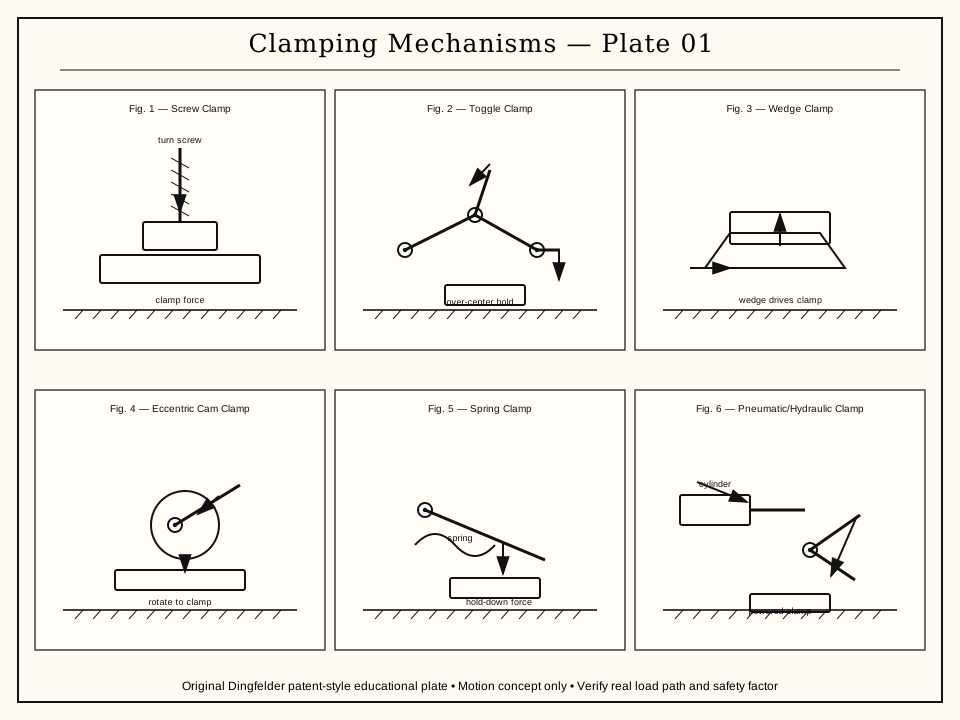
Original Dingfelder patent-style SVG line art. Motion concept drawing only; not a certified load-rated design.
A screw clamp converts turning motion into controlled clamping force.
A toggle clamp creates strong holding force and can lock over center when properly adjusted.
A wedge converts sliding motion into clamping or lifting force.
An eccentric creates quick clamping force as it rotates into contact.
A spring can provide light holding force or return force for a clamp.
Fluid power can apply repeatable clamping force through a lever, arm, or direct actuator.
Motion Created
Clamping mechanisms create holding force, workpiece retention, fixture control, quick lock/release, pressure application, part hold-down, tooling retention, positioning support, and setup repeatability.
Common uses
- fixtures
- vises
- tooling hold-downs
- quick clamps
- machine hold-downs
- changeover tooling
- side clamps
- production fixtures
- automated clamps
Advantages
- holds parts for work
- improves repeatability
- speeds changeover
- supports automation
- allows simple visual inspection
- combines with locators, stops, sensors, and safety systems
Limitations
- too much force can damage parts
- too little force can allow movement
- clamp force can shift the workpiece
- clamp pads wear
- toggle geometry can drift
- screws can loosen
- springs fatigue
- automated clamps can move unexpectedly
- not all clamps are safety-rated
Common Wear / Failure Points
- worn clamp pad
- loose pivot
- bent clamp arm
- stripped threads
- worn toggle pins
- weak spring
- leaking cylinder
- loose locator
- cracked bracket
- part witness marks
- repeated part shift
- inconsistent clamp force
- over-center not fully engaged
Service and Build Notes
Locate First, Clamp Second
Locators define position. Clamps hold that position. A clamp should not force a part into the correct location.
Clamp Force Has a Reaction
The clamping force goes somewhere. Check the support, nest, frame, fasteners, and part distortion.
Do Not Confuse Holding with Safety Locking
A clamp may hold a part during a process but may not be rated to hold a person-safe condition.
Watch for Part Damage
A clamp that solves movement by crushing, bending, marking, or distorting the part is creating a different problem.
R.E.A.L. / Ghost Busting Questions
- Was there a point when the clamp held correctly?
- When did parts start moving, marking, bending, or releasing?
- What changed: part material, thickness, locator, clamp pad, air/hydraulic pressure, toggle adjustment, or tooling?
- Is the clamp holding or dragging the part into position?
- Is the locator worn or loose?
- Is the clamp force too high or too low?
- Is the clamp contacting the intended surface?
- Is the support under the part weak?
Load Capability / Safety Factor Reminder
Clamping mechanisms must be checked for clamp force, reaction force, part distortion, locator strength, pivot capacity, fastener capacity, bracket strength, fatigue, wear, release behavior, guarding, and required safety factor. The clamp, pad, screw, toggle, wedge, eccentric, cylinder, locator, workpiece, fastener, weld, bracket, frame, and support surface are all part of the load path.
Equalize load-carrying capability. Eliminate accidental weak links. Use sacrificial weak links only when they are deliberately engineered, easy to identify, safe when they operate, and protecting something more important.
- actual applied load, torque/force path, stopping energy, and full load path
- materials, pins, bearings, fasteners, guards, brackets, and frame capacity
- heat, wear, shock, acceleration, deceleration, inertia, and fatigue
- guarding, environment, release behavior, and required safety factor
- OEM, site, code, standard, or engineering requirements
Walt says STOP! - Safety First
Make these checks prior to proceeding.
Stop before adjusting, repairing, releasing, or modifying clamping mechanisms when a clamp is holding a load, guard, fixture, or workpiece; release can cause sudden movement; air, hydraulic, spring, or gravity energy is present; fingers can be pinched or crushed; a clamp is part of a safety function; the clamp, locator, bracket, or frame is cracked, loose, or worn; or the load path and safety factor are unknown.
Stop before building, modifying, repairing, releasing, or using this mechanism under load unless the load path, material, pins, pivots, fasteners, welds, frame, guarding, fatigue, wear, environment, and required safety factor have been verified.
Patent & Prior-Art Notes
These mechanism concepts are long-established. Patent references should be treated as representative, improvement, application, or historical examples unless a specific foundational claim is verified.
Final Sourcebook drawings are original Dingfelder drawings and are not copied patent plates. Status not verified. Verify against official patent records before relying on legal status.
Related Mechanisms
- Toggle Mechanisms
- Screw, Wedge & Adjustment Devices
- Levers
- Detents, Latches & Catches
- Guides, Slides & Positioning Devices
- Springs & Stored-Energy Devices