Operator / Floor Team
Start with R.E.A.L., safety stop-points, conveyor line-flow checks, sensor basics, and people-as-tools doctrine.
Start with R.E.A.L.Dingfelder Enterprises Technical Reference Library
A practical field reference for the people who build, repair, measure, wire, weld, align, troubleshoot, improve, and keep industry running.
Foreword · Living Field Manual
The Dingfelder Field Handbook™ is an open-use practical field reference for people who build, repair, measure, wire, weld, align, troubleshoot, improve, train, document, and keep work moving safely. You can read the public handbook, use the glossary, review field guidance, and apply the general concepts without registration.
This handbook is a living document. New sections, examples, worksheets, calculators, field forms, and practical guidance are added regularly — often daily. It is not finished by design: the visible revision stamp tells users exactly which deployed version they are viewing.
Safety boundary: The Field Handbook exists to protect people, animals, and improve work. We do not provide guidance for weapons, explosives, booby traps, or mechanisms intended to harm humans or animals.
Terminology Panel
Use these quick links when a term needs a plain-language definition, then return to this section without losing your place.
Field Card System
The Field Handbook keeps the clean white-card base, but each recurring card type now carries its own field identity so users can tell at a glance whether they are looking at safety, terminology, evidence capture, reverse-trace logic, quality checks, recipe logging, calculations, or mechanical sourcebook guidance.
Command Center
Start from the lane that matches the job in front of you. The Field Handbook explains the discipline, the Sourcebook shows the mechanism, the calculators support first-pass awareness, and the Methodology keeps the human, safety, and judgment in control.
Practical pages for machining, measurement, materials, mechanical systems, fluids, air, sensors, controls, and troubleshooting.
SeeOriginal patent-style visual plates that explain motion, force, timing, holding, release, wear, and failure points.
CalculateConnect live calculators to load path awareness, power transfer, electrical loading, cylinder force, analog scaling, VFD speed, and more.
TroubleshootRapidly Evaluate, Adjust, Learn. Rapid does not mean rushed. Capture the ghost before it disappears.
FlowGuided S.W.A.T. first-check paths for jams, false triggers, VFD faults, cylinders, motor overloads, and change-window discovery.
ImproveListen first, protect people, follow the load path, use AI responsibly, simplify intelligently, and grow the system.
GateChecklist, request workflow, response templates, expansion lanes, and the protected admin queue blueprint.
CrankAutomotive S.W.A.T. pack for no-starts, misfires, OBD-II clue discipline, sensor truth, and parts-cannon prevention.
AuditCheck Field Form Builder™, calculators, Field Manual coverage, live readiness, and the next gap queue before expanding.
CoachRespectful communication, listening, difficult conversation prep, training patience, ownership, culture, and escalation boundaries.
Mission
Industrial problems rarely stay inside one discipline. A machine symptom may involve mechanics, sensors, controls, air pressure, timing, product handling, maintenance history, and measurement error.
Built for real work
The handbook helps users connect concepts, calculators, first checks, stop-points, and related systems instead of treating disciplines as isolated silos.
Dingfelder Methodology
A core Dingfelder engineering principle is simple: Engineer to the best of your ability. Utilize all resources available. Then ask: “How can I simplify this design?”
Resources begin with people before tools: learn to listen, abandon your ego, remember nobody is better than anyone else, and adopt humility. The janitor may be walking around with the key thought that solves the toughest issue.
Doctrine anchor
The practical doctrine behind the Field Handbook, Devices & Mechanisms Sourcebook™, R.E.A.L., S.W.A.T., Ghost Busting™, A.I.R.O.N., AI stewardship, simplification, safety, leadership, and machine thinking.
Core line
R.E.A.L. is the root doctrine of troubleshooting. Humans are the authoritative part of the machine. AI is a tool that should make humans better informed, not less responsible.
Visual companion now live
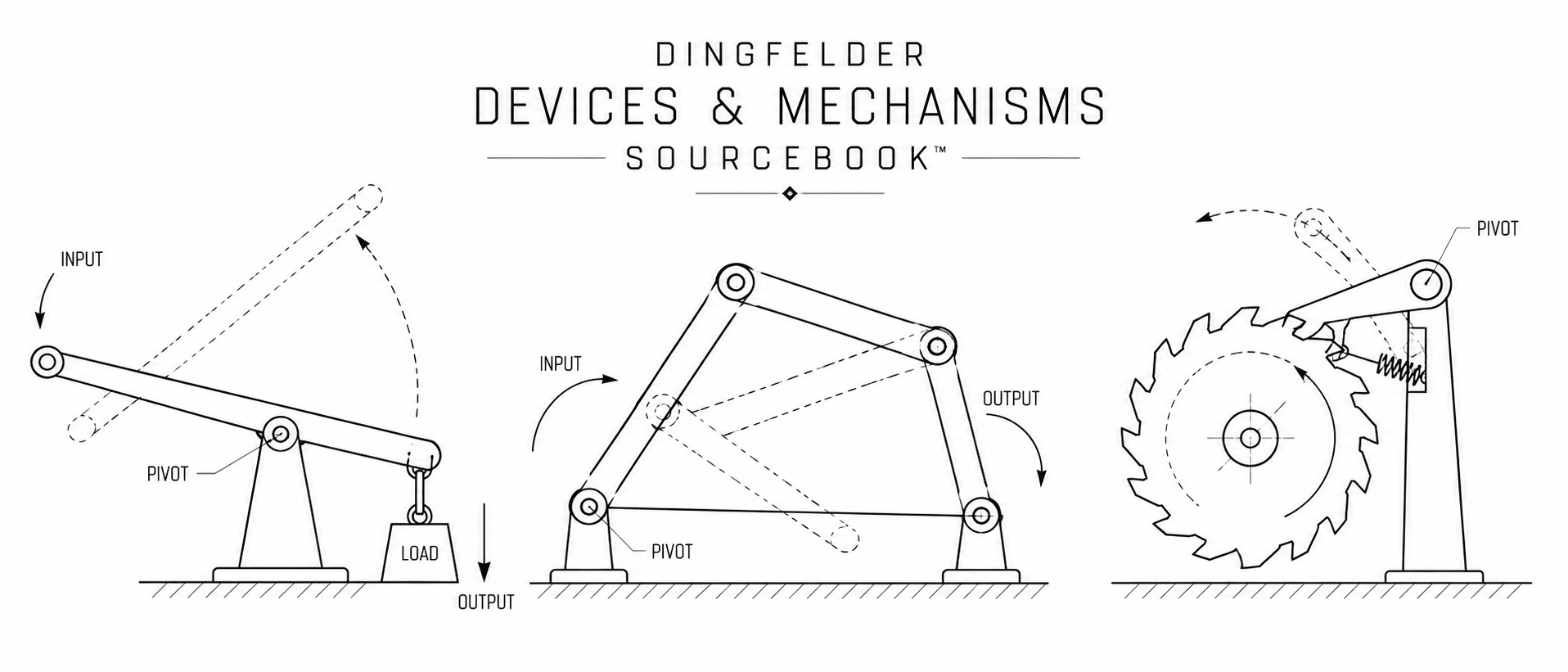
A drawing-rich mechanical idea library using original Dingfelder patent-plate style drawings to explain motion, force, timing, holding, release, adjustment, wear, and failure points.
A picture is a thousand words — in any language.
Next practical layer
Connect handbook explanations and Sourcebook mechanisms to practical first-pass field tools: safety factor, load path awareness, lever torque, gear ratios, conveyor speed, hydraulic force, pneumatic force, analog scaling, VFD speed, and electrical loading awareness.
Read it. See it. Calculate it. Troubleshoot it. Improve it.
Rev v34 User Manual
The manual is moving from a flat two-digit list into practical work-lane groups with FM category codes, section numbers, companion calculators, and coverage status.
No section stands alone. Every new Field Manual section must point to an existing calculator/workbench, identify a needed calculator module, or state why no calculator is required.
Where should I start?
The same machine problem may look different to an operator, mechanic, engineer, supervisor, student, or business owner. These lanes help users start with the right mental model and move across disciplines without getting lost.
Start with R.E.A.L., safety stop-points, conveyor line-flow checks, sensor basics, and people-as-tools doctrine.
Start with R.E.A.L.Use mechanical first checks, Sourcebook mechanism plates, load path awareness, lubrication, bearings, shafts, belts, chains, hydraulics, and pneumatics.
Open Mechanical First ChecksStart with the Sourcebook, safety factor doctrine, Machine That Builds the Machine, fixtures, guards, calculators, and Simplification Pass™.
Open Machine ThinkingUse R.E.A.L., Ghost Busting™, Coach™, human CI doctrine, H.M.M.M.A.A.I.™, simplification as expansion, and AI stewardship.
Open Coach™Learn the ladder: parts → assemblies → mechanisms → machines → systems → the machine that builds the machine.
Open the SourcebookStart with the Methodology, AI stewardship, simplification as expansion, and tools that preserve knowledge while growing capability.
Open AI StewardshipCore Handbook Sections
Use these core sections as the starting library for foundation topics, machining and shop math, tolerances, inspection, quality, materials, fabrication, mechanical systems, fluids, air, motion, electrical, sensors, controls, and production equipment troubleshooting.
foundation
How to use the handbook, source policy, safety boundaries, units, conversions, and measurement basics.
machining shop math
RPM, SFM, feed rate, chip load, drill sizes, tap drill basics, thread identification, and fits.
tolerances inspection quality
Shop-floor tolerances, GD&T basics, datums, measurement tools, runout, flatness, parallelism, and perpendicularity.
materials fabrication
Common metals, material selection, hardness, heat treat, welding, distortion, fit-up, tack strategy, and repair cautions.
mechanical systems
Bearings, shafts, keys, couplings, alignment, belts, chains, sprockets, lubrication, contamination, and first checks.
fluids air motion
Hydraulic pressure, force, flow, cylinder speed, pneumatics, air preparation, leaks, vacuum, suction cups, and pick-and-place basics.
electrical sensors controls
Electrical field basics, sensors, PNP/NPN, sinking/sourcing, analog signals, VFD first checks, and PLC I/O sanity checks.
production equipment troubleshooting
Conveyor jams, line flow, timing, product movement, first checks, and cross-discipline troubleshooting.
Handbook directory
Search by topic, discipline, field issue, or term. Each page connects back to safety boundaries, source policy, related calculators, and related handbook pages.
User manual for the living Field Handbook system: Field Manual categories, Field Calculators™, Sticky™, Field Form Builder™, Guided RCP packets, Expert Process Development Mode, RCP Tracker, reports, requests, and safety boundaries.
03Source Credit, Standards & No-Plagiarism PolicyFoundationThe Dingfelder Field Handbook™ is original practical field content. Learn how Dingfelder handles source credit, standards, OEM references, protected tables, and attribution.
04Safety, Liability & Field-Use DisclaimerFoundationThe Dingfelder Field Handbook™ is a practical field reference, not a substitute for official standards, OEM manuals, site safety procedures, qualified tradespeople, engineering review, or code authority.
05Units, Conversions & Measurement BasicsFoundationUnderstand inch and metric units, fractions, decimals, tolerances, measurement uncertainty, and common conversion mistakes in practical industrial field work.
06RPM, SFM & Cutter Speed BasicsMachining & Shop MathUnderstand spindle RPM, surface feet per minute, cutter speed, material effects, tool diameter, and practical first checks for machining speed decisions.
07Feed Rate, Chip Load & Tool Life BasicsMachining & Shop MathUnderstand feed rate, chip load, flute count, tool life, rubbing, chatter, chip evacuation, and practical machining feed decisions.
08Drill Size, Tap Drill & Thread BasicsMachining & Shop MathUnderstand drill sizes, tap drill basics, thread percentage, coarse and fine thread awareness, hole preparation, and practical first checks before tapping.
09Thread Pitch, TPI & Fastener IdentificationMachining & Shop MathUnderstand thread pitch, threads per inch, metric and inch fastener identification, thread gauges, diameter checks, and practical first steps before replacing or cutting threads.
10Clearance, Transition & Interference FitsMachining & Shop MathUnderstand clearance fits, transition fits, interference fits, practical fit behavior, shaft and hole relationships, and first checks before machining or assembling parts.
11Tolerances for the Shop FloorTolerances, Inspection & QualityUnderstand practical tolerance meaning, nominal size, tolerance zones, decimal places, inspection reality, and first checks before machining, measuring, or accepting a part.
12GD&T Basics Without the ConfusionTolerances, Inspection & QualityUnderstand geometric dimensioning and tolerancing in practical field language: datums, feature control frames, form, orientation, location, runout, and inspection meaning.
13Datums, Feature Control Frames & Inspection RealityTolerances, Inspection & QualityUnderstand datums, datum reference frames, feature control frames, basic dimensions, inspection setup, and practical shop-floor GD&T interpretation.
14Calipers, Micrometers & Indicator BasicsTolerances, Inspection & QualityUnderstand practical use of calipers, micrometers, dial indicators, test indicators, setup checks, tool limits, measurement habits, and common inspection mistakes.
15Runout, Flatness, Parallelism & PerpendicularityTolerances, Inspection & QualityUnderstand runout, flatness, parallelism, perpendicularity, practical inspection meaning, machine symptoms, first checks, and field measurement cautions.
16Common Metals: Steel, Stainless, Aluminum & BrassMaterials & FabricationUnderstand practical differences between common metals used in industrial work, including steel, stainless steel, aluminum, brass, machinability, corrosion, welding, wear, and field cautions.
17Material Selection for Field RepairsMaterials & FabricationLearn practical field-repair material selection principles for industrial maintenance, including function, load, environment, weldability, machinability, corrosion, safety, and substitution cautions.
18Hardness, Heat Treat & Wear BasicsMaterials & FabricationUnderstand practical hardness, heat treatment, wear, case hardening, surface damage, brittleness, machinability, and field cautions for industrial repair and machining.
19Welding & Fabrication Field BasicsMaterials & FabricationUnderstand practical welding and fabrication basics for industrial field work, including fit-up, material identification, process awareness, safety, distortion, weld purpose, and repair cautions.
20Distortion, Fit-Up, Tack Strategy & Repair CautionsMaterials & FabricationUnderstand welding distortion, fit-up, tack strategy, heat control, repair planning, alignment preservation, and practical field cautions for fabrication and industrial repair.
21Bearings: Types, Symptoms & Failure CluesMechanical SystemsUnderstand practical bearing types, failure clues, noise, heat, vibration, lubrication, contamination, fit, alignment, and first checks before replacing bearings.
22Shafts, Keys, Couplings & Alignment BasicsMechanical SystemsUnderstand practical shaft, key, coupling, and alignment basics, including torque transfer, fits, runout, keyway wear, misalignment symptoms, and first checks.
23Belts, Chains, Sprockets & PulleysMechanical SystemsUnderstand practical belt and chain drive basics, tension, alignment, sprocket and pulley wear, guarding, speed ratios, failure clues, and first checks.
24Lubrication, Grease, Oil & Contamination BasicsMechanical SystemsUnderstand practical lubrication basics, grease, oil, contamination, overgreasing, underlubrication, compatibility, cleanliness, seals, and first checks for industrial equipment.
25Mechanical Troubleshooting First ChecksMechanical SystemsUse a practical first-check sequence for mechanical troubleshooting, including safety, listening, recent changes, symptoms, energy sources, looseness, wear, alignment, lubrication, and escalation.
26Hydraulic Pressure, Force, Flow & Cylinder SpeedFluids, Air & MotionUnderstand practical hydraulic pressure, force, flow, cylinder speed, stored energy, leaks, heat, contamination, and first checks before troubleshooting hydraulic systems.
27Pneumatic Systems, Air Prep & Leak CluesFluids, Air & MotionUnderstand practical pneumatic systems, compressed air, air preparation, FRLs, leaks, cylinders, valves, flow controls, pressure drops, moisture, and first checks.
28Vacuum, Suction Cups & Pick-and-Place BasicsFluids, Air & MotionUnderstand practical vacuum systems, suction cups, pick-and-place handling, leaks, surface condition, vacuum generators, filters, release timing, and first checks.
29Electrical Field Basics: Voltage, Current, Resistance & PowerElectrical, Sensors & ControlsUnderstand practical electrical basics for field troubleshooting: voltage, current, resistance, power, AC/DC awareness, loads, circuits, meters, and safe first checks.
30Sensors: Prox, Photoeye, Limit Switch & Encoder BasicsElectrical, Sensors & ControlsUnderstand practical industrial sensor basics, including proximity sensors, photoeyes, limit switches, encoders, target condition, infrared interference, alignment, wiring, contamination, and first checks.
31PNP vs. NPN, Sinking vs. SourcingElectrical, Sensors & ControlsUnderstand practical PNP and NPN sensor wiring, sinking and sourcing inputs, common wiring mistakes, PLC input compatibility, and first checks.
324–20 mA, 0–10 VDC & Analog Signal BasicsElectrical, Sensors & ControlsUnderstand practical analog signal basics, including 4–20 mA loops, 0–10 VDC signals, scaling, sensor range, wiring, noise, commons, and first checks.
33VFD Fault First ChecksElectrical, Sensors & ControlsUnderstand practical first checks for variable-frequency drive faults, including overload, overcurrent, overvoltage, undervoltage, heat, wiring, motor load, parameters, and safety.
34PLC I/O Sanity ChecksElectrical, Sensors & ControlsUnderstand practical PLC input/output sanity checks, including sensor status, outputs, wiring, commons, permissives, field devices, logic, forcing cautions, and first checks.
35Conveyor Jam Troubleshooting & Line-Flow First ChecksProduction Equipment & TroubleshootingUse practical first checks for conveyor jams and production line-flow problems, including product changes, guides, belts, sensors, pneumatics, timing, drives, operators, and safe troubleshooting.
36Field Handbook Public Readiness GateFoundationChecklist, request review workflow, response templates, expansion lanes, and the protected admin queue blueprint for the living Field Handbook.