Walt — Simple Man Takeaway
A guard that people remove and leave off is a design problem wearing a safety label.
Guards, Covers & Access Mechanisms — Plate 01
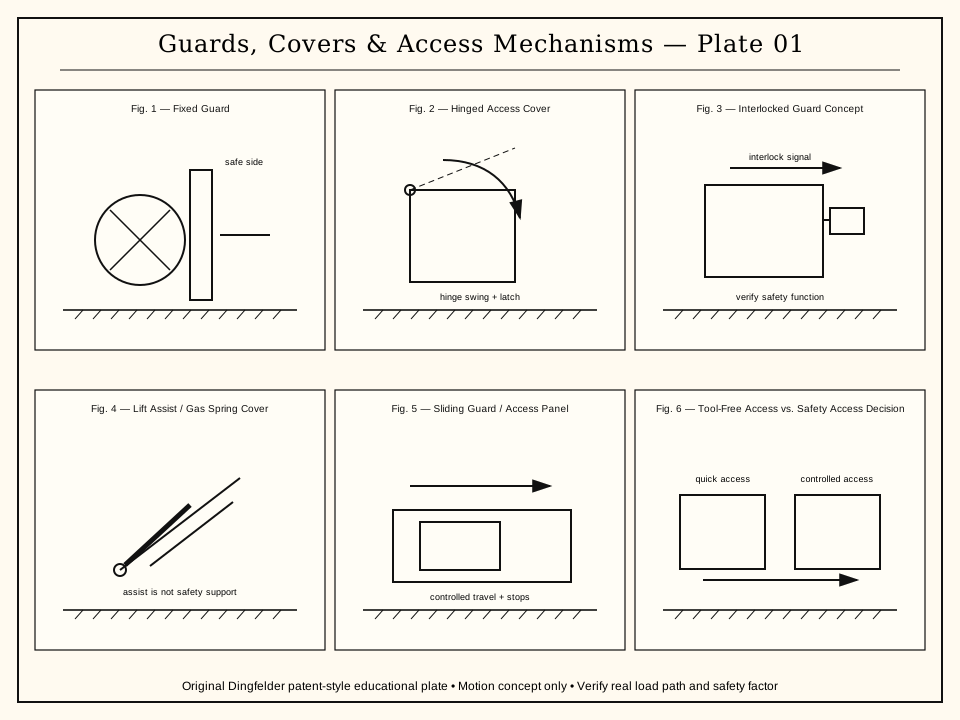
Original Dingfelder patent-style SVG line art. Motion concept drawing only; not a certified load-rated design.
Shows the core visual concept for this mechanism family.
Highlights the relationship between motion, support, and timing.
Explains where force, guidance, or control enters the system.
Shows a practical field variation and its important checks.
Shows how the concept changes in production or service use.
Connects the mechanism to safe operation and maintainability.
Function Created
hazard separation, controlled access, service access, inspection access, containment, reach limitation, controlled opening and closing, safe maintenance pathways, and machine/environment protection.
Common uses
- belt and chain guards
- rotating equipment covers
- pinch-point protection
- inspection covers
- machine panels
- guarded access doors
- robotic cells
- service openings
Advantages
- protects people from hazards
- protects mechanisms from contamination
- improves service access when designed well
- supports inspection and cleaning
- reduces unsafe improvisation
- helps define safe machine boundaries
- supports lockout/tagout and maintenance planning
Limitations
- poorly designed guards get removed
- heavy covers can fall
- gas springs can fail
- latches can wear
- hinges can sag
- interlocks can be misapplied or bypassed
- sliding panels can pinch
- access may be too difficult for routine maintenance
Common Wear / Failure Points
- missing guard fasteners
- cracked cover
- bent guard
- sagging hinge
- worn latch
- weak gas spring
- failed prop rod
- misaligned interlock actuator
- damaged switch
- guard rubbing moving parts
- sharp guard edges
- cover left off
- bypassed interlock
Service and Build Notes
Guarding Is Part of the Machine
A guard is not an afterthought. It changes access, inspection, maintenance, cleaning, and safety behavior.
Access Must Match the Task
If a part needs daily inspection, access should not require an unreasonable fight. If access exposes hazardous motion, it must be controlled.
Lift Assists Are Not Safety Supports
Gas springs and lift assists can fail. Heavy covers need proper secondary support where failure could injure someone.
Design Against Bypass
People bypass guards when the guard prevents necessary work. Good design reduces that temptation.
R.E.A.L. / Ghost Busting Questions
- Was there a point when the guard or access worked correctly?
- When did it become hard to use, bypassed, damaged, or left off?
- What changed: maintenance task, product buildup, hinge, latch, gas spring, interlock, tool access, or cleaning requirement?
- Is the guard protecting the real hazard?
- Does the guard create a new pinch or crush point?
- Is the access path practical for the work being done?
- Are people bypassing it because the design blocks necessary work?
Load Capability / Safety Factor Reminder
Guards, covers, hinges, latches, lift assists, interlocks, fasteners, brackets, and frames must be checked for real load, vibration, opening force, falling cover hazards, fatigue, wear, guarding coverage, access behavior, and required safety factor.
Equalize load-carrying capability. Eliminate accidental weak links. Use sacrificial weak links only when they are deliberately engineered, easy to identify, safe when they operate, and protecting something more important.
- actual applied load, force path, stopping energy, and full load path
- materials, fasteners, welds, guards, brackets, and frame capacity
- wear, shock, acceleration, deceleration, inertia, and fatigue
- guarding, environment, release behavior, and required safety factor
- OEM, site, code, standard, or engineering requirements
Walt says STOP! - Safety First
Make these checks prior to proceeding.
Stop before modifying, removing, bypassing, or redesigning guards, covers, and access mechanisms when hazardous motion is behind the guard; the guard is part of an interlock or safety function; a cover can fall, swing, slide, or pinch; stored energy is present; or people are bypassing the guard to do normal work.
Stop before building, modifying, repairing, releasing, or using this mechanism under load unless the load path, material, pins, pivots, fasteners, welds, frame, guarding, fatigue, wear, environment, and required safety factor have been verified.
Patent & Prior-Art Notes
These mechanism concepts are long-established and may combine many older principles. Patent references should be treated as representative, improvement, application, or historical examples unless a specific foundational claim is verified.
Final Sourcebook drawings are original Dingfelder drawings and are not copied patent plates. Status not verified. Verify against official patent records before relying on legal status.
Related Mechanisms
- Detents, Latches & Catches
- Springs & Stored-Energy Devices
- Clamping Mechanism Plates
- Guides, Slides & Positioning Devices
- Screw, Wedge & Adjustment Devices
- Machine That Builds the Machine Plates