Walt — Simple Man Takeaway
Moving the part is easy. Moving it straight, on time, without dropping it, crushing it, or fighting the next station is where the machine tells the truth.
Transfer Mechanisms — Plate 01
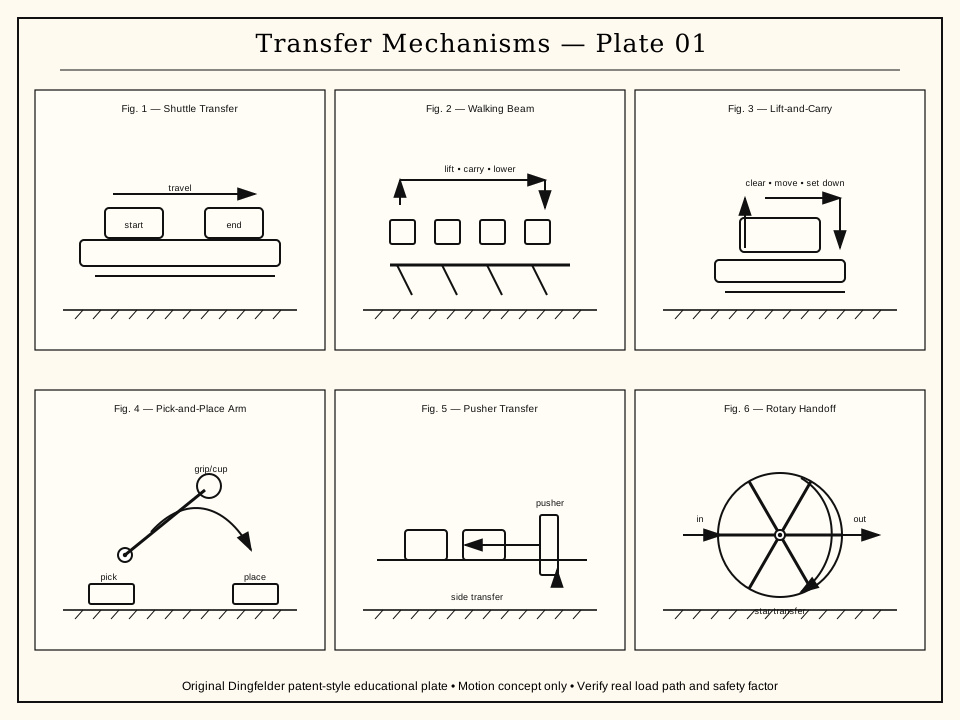
Original Dingfelder patent-style SVG line art. Motion concept drawing only; not a certified load-rated design.
A shuttle moves a part between two stations along a guided path.
A walking beam lifts parts, carries them forward one station, lowers them, and returns.
A lift-and-carry transfer raises the part clear, moves it, then lowers it into the next position.
A pick-and-place mechanism picks a part from one location and places it at another.
A pusher moves product or parts sideways, forward, or into another path.
A rotary transfer can space, carry, and hand off product between paths or stations.
Motion Created
Transfer mechanisms create part movement between stations, product handoff, lift-and-carry action, shuttle motion, pick-and-place motion, push/reject motion, rotary handoff, station-to-station flow, and guided part presentation.
Common uses
- load/unload devices
- station-to-station transfer
- packaging handoffs
- assembly fixtures
- progressive transfer lines
- part transfer
- reject pushers
- lane changers
- rotary packaging machines
Advantages
- moves parts between operations
- supports automation
- reduces manual handling
- controls spacing and orientation
- coordinates multiple stations
- can be mechanical, pneumatic, servo, or hybrid
- easy to understand visually when drawn clearly
Limitations
- timing matters
- part support matters
- dropped parts can jam machines
- guides can wear or shift
- grippers or cups can lose hold
- pushers can damage product
- transfer speed can create inertia and bounce
- pinch, crush, and shear points are common
Common Wear / Failure Points
- loose shuttle guide
- worn slide or rail
- bent pusher finger
- gripper wear
- vacuum cup wear
- weak cylinder
- air leaks
- loose nests
- poor handoff timing
- product bounce
- dropped parts
- transfer arm play
- inconsistent return position
Service and Build Notes
A Transfer Has Four Jobs
Pick it up, carry it, place it, and get out of the way. If one job is late, weak, crooked, or rough, the whole transfer becomes a jam source.
Handoff Timing Is Everything
The receiving station must be ready before the part arrives. The sending station must let go when the receiving station takes control.
Product Support Matters
A part supported at rest may not be supported during acceleration, deceleration, rotation, or handoff.
Check the Return Stroke
Many transfer problems happen on the return stroke, especially when the mechanism catches product, tooling, wires, hoses, or guards.
R.E.A.L. / Ghost Busting Questions
- Was there a point when the transfer worked correctly?
- When did drops, jams, bad placement, or timing issues begin?
- What changed: product, speed, tooling, gripper, vacuum, air pressure, sensor, guide, or downstream station?
- Does the part fail during pickup, travel, placement, or return?
- Is the receiving station ready?
- Is the part supported through the entire path?
- Are guides, nests, or stops loose?
- Is the visible jam downstream from the first bad handoff?
Load Capability / Safety Factor Reminder
Transfer mechanisms must be checked for part weight, inertia, acceleration, deceleration, grip force, guide load, actuator force, stop impact, fatigue, wear, guarding, and required safety factor. The gripper, cup, pusher, arm, guide, slide, cylinder, linkage, fastener, weld, bracket, frame, and product are all part of the load path.
Equalize load-carrying capability. Eliminate accidental weak links. Use sacrificial weak links only when they are deliberately engineered, easy to identify, safe when they operate, and protecting something more important.
- actual applied load, torque/force path, stopping energy, and full load path
- materials, pins, bearings, fasteners, guards, brackets, and frame capacity
- heat, wear, shock, acceleration, deceleration, inertia, and fatigue
- guarding, environment, release behavior, and required safety factor
- OEM, site, code, standard, or engineering requirements
Walt says STOP! - Safety First
Make these checks prior to proceeding.
Stop before adjusting, clearing, repairing, or modifying transfer mechanisms when parts can drop, launch, pinch, shear, crush, or trap; a transfer can move automatically; air, hydraulic, servo, cam, spring, or gravity energy is present; hands can enter pick, carry, place, or return paths; product is jammed in the transfer path; sensors or interlocks are being bypassed; or the load path and safety factor are unknown.
Stop before building, modifying, repairing, releasing, or using this mechanism under load unless the load path, material, pins, pivots, fasteners, welds, frame, guarding, fatigue, wear, environment, and required safety factor have been verified.
Patent & Prior-Art Notes
These mechanism concepts are long-established. Patent references should be treated as representative, improvement, application, or historical examples unless a specific foundational claim is verified.
Final Sourcebook drawings are original Dingfelder drawings and are not copied patent plates. Status not verified. Verify against official patent records before relying on legal status.
Related Mechanisms
- Guides, Slides & Positioning Devices
- Feed & Escapement Concepts
- Indexing Tables & Rotary Transfer Concepts
- Cams & Followers
- Four-Bar Linkages
- Vacuum, Suction Cups & Pick-and-Place Basics