Walt — Simple Man Takeaway
A machine that builds the machine is not magic. It is a thousand simple truths forced to agree with each other every cycle.
Machine That Builds the Machine — Plate 01
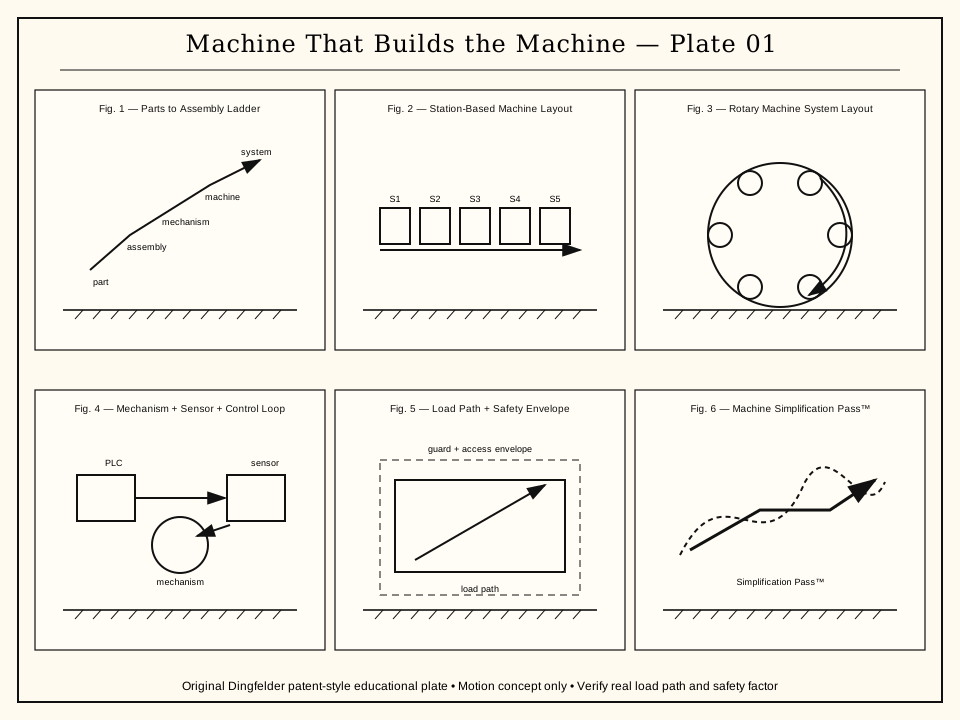
Original Dingfelder patent-style SVG line art. Motion concept drawing only; not a certified load-rated design.
Shows the core visual concept for this mechanism family.
Highlights the relationship between motion, support, and timing.
Explains where force, guidance, or control enters the system.
Shows a practical field variation and its important checks.
Shows how the concept changes in production or service use.
Connects the mechanism to safe operation and maintainability.
Function Created
controlled part flow, sequenced station behavior, repeated production cycles, coordinated mechanisms, sensor-driven confirmation, operator access paths, maintenance access paths, safe guarding boundaries, quality checkpoints, and simplified machine logic.
Common uses
- teaching system thinking
- machine design planning
- assembly and packaging machines
- custom automation
- A.I.R.O.N. / V.A.U.L.T. machine intelligence context
- retrofit planning
Advantages
- teaches system thinking
- connects all Sourcebook mechanism families
- supports training across disciplines
- helps troubleshoot line-wide issues
- makes hidden dependencies visible
- supports machine design and retrofit planning
- reinforces Dingfelder Methodology™
Limitations
- system drawings can hide local detail
- every station still needs its own load-path check
- controls do not fix bad mechanics
- mechanics do not fix bad logic
- guarding can be compromised if access is poorly planned
- simplifying without understanding can remove needed function
Common Wear / Failure Points
- unclear station purpose
- too many mechanisms solving one problem
- weak transfer between stations
- product not fully located before clamping
- sensors confirming the wrong condition
- inaccessible maintenance points
- guards removed because access is poor
- one station causing downstream blame
- undocumented adjustment points
- controls hiding mechanical drift
Service and Build Notes
Define the Job of Each Station
Every station should have a clear job. If a station’s purpose cannot be explained simply, the design may already be drifting.
Controls Confirm Reality — They Do Not Create It
A sensor can confirm position, but it cannot make a loose guide accurate. A PLC can command motion, but it cannot remove a mechanical bind.
Maintenance Access Is a Design Feature
If people cannot safely inspect, clean, lubricate, or replace wear parts, the machine will eventually be maintained badly.
Simplification Is an Expansion Function
Engineer fully, use every resource, then simplify to improve safety, quality, maintainability, training clarity, reliability, and growth — not as a lazy headcount reduction tool.
R.E.A.L. / Ghost Busting Questions
- Was there a point when the machine ran correctly as a system?
- When did the station-to-station behavior begin to fail?
- What changed: product, speed, tooling, controls, sensor, guard, operator access, maintenance, or station timing?
- Which station first produces a bad part or bad motion?
- Is the visible jam downstream from the first bad station?
- Are sensors confirming the right reality?
- Is a mechanism doing two jobs when it should only do one?
- What can be simplified without removing required function or safety?
Load Capability / Safety Factor Reminder
System-level machine drawings do not prove load capability. Every station, mechanism, transfer, clamp, guide, frame, fastener, weld, bearing, actuator, guard, and access feature must be checked against the real application.
Equalize load-carrying capability. Eliminate accidental weak links. Use sacrificial weak links only when they are deliberately engineered, easy to identify, safe when they operate, and protecting something more important.
- actual applied load, force path, stopping energy, and full load path
- materials, fasteners, welds, guards, brackets, and frame capacity
- wear, shock, acceleration, deceleration, inertia, and fatigue
- guarding, environment, release behavior, and required safety factor
- OEM, site, code, standard, or engineering requirements
Walt says STOP! - Safety First
Make these checks prior to proceeding.
Stop before building, modifying, retrofitting, bypassing, or operating machine systems when a station can move automatically; guards, covers, or interlocks are incomplete; people can enter the path of moving product or tooling; one mechanism can trigger another unexpectedly; stored energy is present; or the load path, station timing, or safety function is unknown.
Stop before building, modifying, repairing, releasing, or using this mechanism under load unless the load path, material, pins, pivots, fasteners, welds, frame, guarding, fatigue, wear, environment, and required safety factor have been verified.
Patent & Prior-Art Notes
These mechanism concepts are long-established and may combine many older principles. Patent references should be treated as representative, improvement, application, or historical examples unless a specific foundational claim is verified.
Final Sourcebook drawings are original Dingfelder drawings and are not copied patent plates. Status not verified. Verify against official patent records before relying on legal status.
Related Mechanisms
- Packaging / Production Machine Mechanism Plates
- Transfer Mechanisms
- Clamping Mechanism Plates
- Indexing Tables & Rotary Transfer Concepts
- Guides, Slides & Positioning Devices
- Feed & Escapement Concepts