Walt — Simple Man Takeaway
Don’t chase what’s working. Chase what’s stopping the rung from winning.
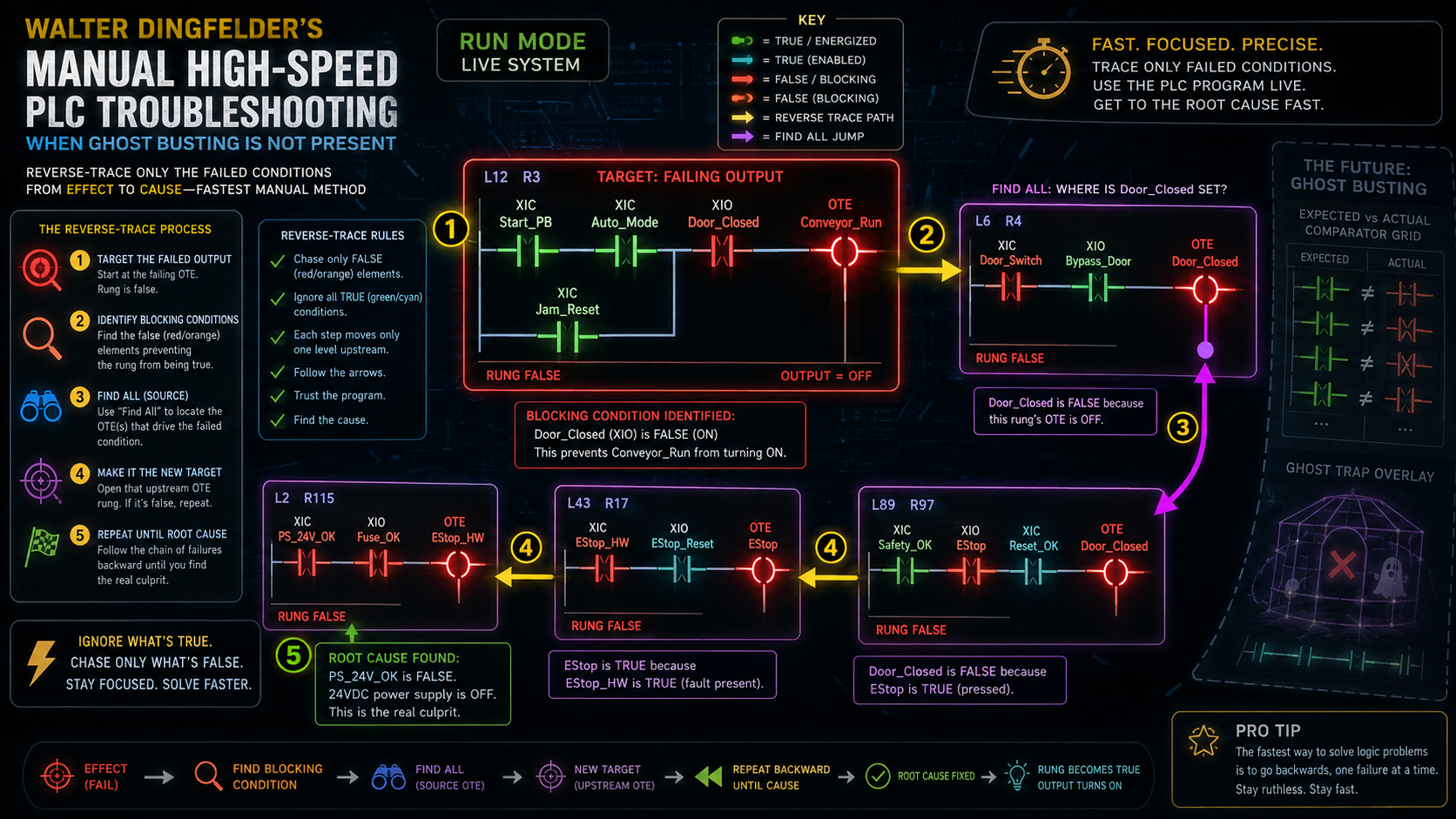
This is the core of Reverse-Trace Logic Solving™: ignore conditions already proving true and move backward through the conditions blocking the result.
Reverse-Trace Logic Solving™ vs. Ghost Busting™
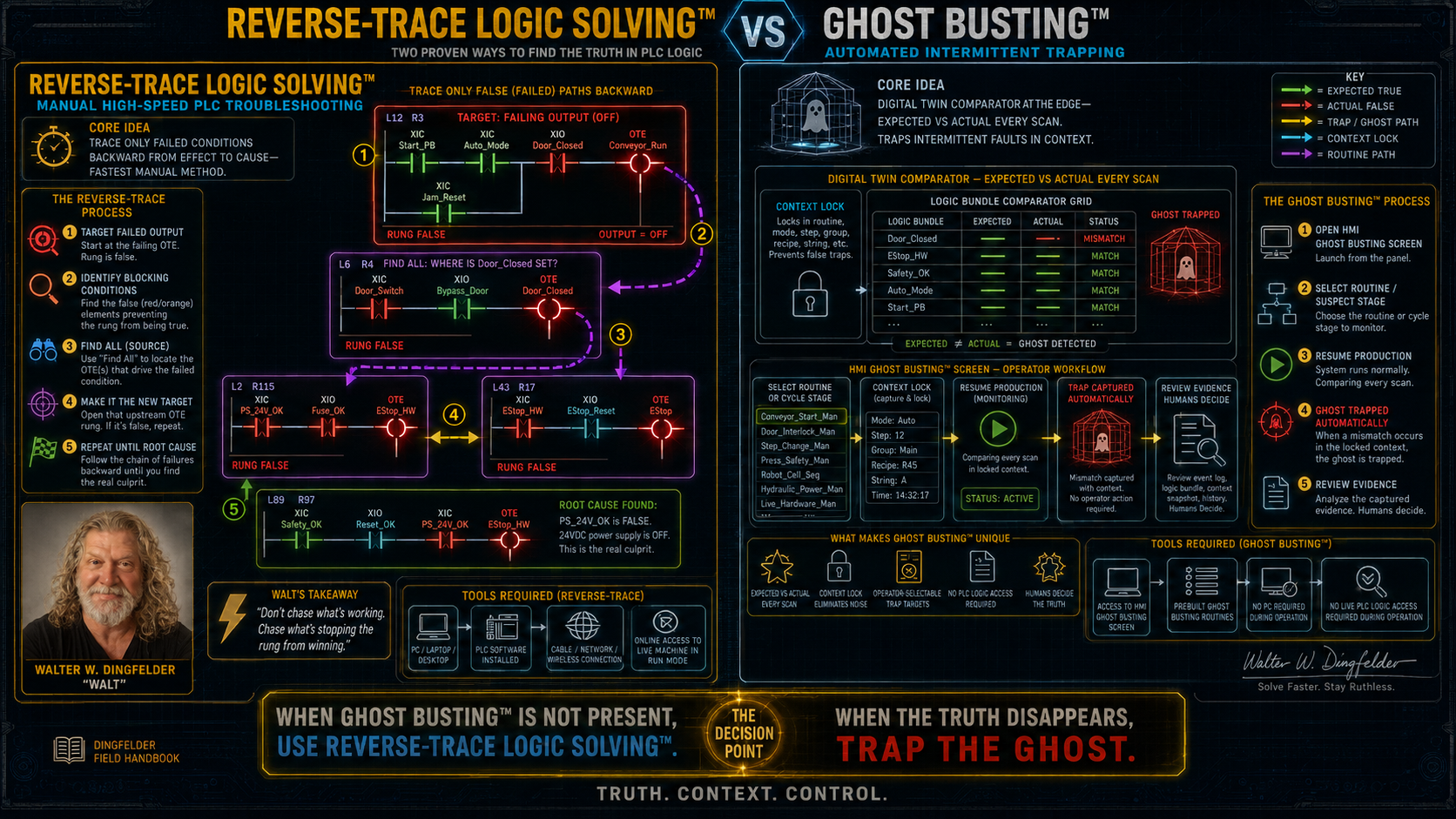
Primary teaching graphic: this infographic shows the operating difference between manual Reverse-Trace Logic Solving™ and automated Ghost Busting™ — including tools required, when to use each method, and how Ghost Busting™ traps the truth when the fault disappears.
Manual Reverse-Trace Flow Graphic
This original teaching visual focuses only on the manual reverse-trace method: failed output → blocking condition → Find All → source OTE → new target → repeat until the field culprit is found.
Plain-English Definition
Reverse-Trace Logic Solving™ is a live RUN-mode manual PLC ladder-logic troubleshooting method.
The technician starts at the failed rung output or failed result, identifies only the logical conditions preventing that rung from becoming true, traces those failed conditions backward to their driving outputs, and continues failure-to-failure until the true field cause is found.
This is not proprietary voodoo, reverse engineering, or secret process ownership. It is the human integrating into the logic machine and adapting to its way of thinking — logically.
Tools Required
Manual live-logic tools
PC, laptop, or desktop with the PLC programming software / live logic program installed, the correct project or online controller access, and a cable, network, or approved wireless method to go online with the live machine.
Qualified live access
Qualified access to monitor the live program in RUN mode, authorization to troubleshoot the equipment, and site safety / lockout boundaries understood before any live work begins.
HMI access instead of PC access
Ghost Busting™ normally requires access to the HMI Ghost Busting™ screen after routines have been developed and hosted on the all-in-one HMI/controller or V.A.U.L.T.™ edge PC.
Critical Difference: Manual Reverse-Trace vs. Ghost Busting™
Manual live-logic method. The technician uses the PLC program as the troubleshooting map. A PC and online access to the live logic are required. Best for stable visible failures that can be observed while the technician is online.
Automated evidence-capture method. The HMI / V.A.U.L.T. system monitors expected vs. actual behavior through prebuilt Ghost Busting™ routines. A PC and live PLC logic access are not required by the operator during normal operation.
Reverse-Trace Logic Solving™ uses the human and live PLC program to find the current failure. Ghost Busting™ uses the HMI / V.A.U.L.T. / edge comparator to trap the intermittent failure when no human is lucky enough to see it.
Ghost Busting™ Operator Workflow
Reverse-Trace Logic Solving™ Method
The Reverse-Trace Rule
One failed rungOne failed conditionOne driving OTERepeat
Why Technicians Freeze
Large ladder programs can overwhelm good people. Some respond fluidly under pressure. Others freeze because they were never given a calm, structured path for how to think through the logic.
Reverse-Trace Logic Solving™ turns panic into sequence. It gives the mind one next step instead of the whole program at once.
Common Mistakes
- chasing conditions that are already true
- getting distracted by every logic use
- focusing on XIC/XIO references instead of the driving OTE
- trying to solve the problem offline only
- not reviewing live in RUN mode
- jumping around emotionally instead of following the failed chain
- tracing too broadly instead of failure-to-failure
Mechanical / Motion S.W.A.T. Pack
When the logic is true but the machine still fails to move correctly, shift from logic solving to the physical motion path: load, alignment, wear, friction, timing, and transfer control.
Walt says STOP! - Safety First
Make these checks prior to proceeding.
Stop before live logic troubleshooting when you are not qualified or authorized to go online, force-starting outputs could create danger, someone is inside guarding, machine motion can restart unexpectedly, troubleshooting requires bypassing safety, lockout/tagout is required, live electrical exposure is present, or the step could injure someone or damage equipment.
Use the logic as a diagnostic tool. Do not let troubleshooting create a new hazard.