Crank™ Cool Down Discipline
Slow the repair down before it costs more.
The Cool Down Page is not a sales page. It is the reset button for diagnostics. Pause, document what is known, separate proof from assumptions, and return to the vehicle with a clear head.
You’re smart. You can do this. Just do not let the problem get inside your head.
Don’t let Crank turn into Cranky.
When frustration starts running the repair, pause before the problem gets worse.
You’re smart. You can do this.
Just do not let the problem get inside your head.
Modern vehicles can be frustrating by design. Special tools, special instruments, hidden procedures, proprietary information, computer-controlled systems, security locks, service resets, and manufacturer-specific diagnostics can make a good technician feel like they are missing something obvious.
Do not beat yourself up for not knowing something that was designed to be hard to know.
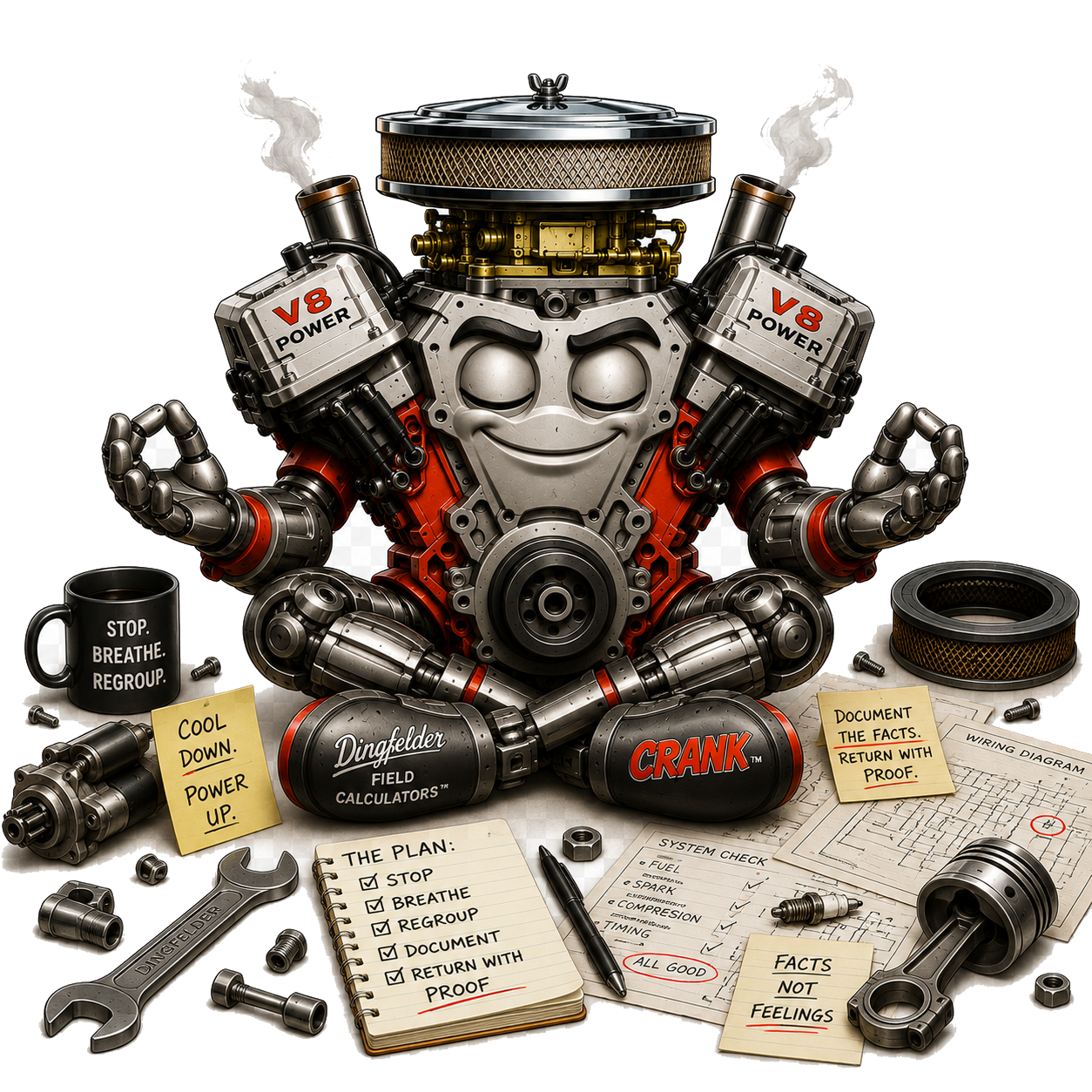
Cool Down Discipline
If you find yourself in a parts-changing trap, led by bad advice, or if you are getting frustrated — walk away.
- Take a break for at least 10 minutes.
- Think about anything else.
- Regroup before touching the vehicle again.
- Write down everything you have tried.
- Separate what is proven from what is assumed.
Write It Down
- What is the actual complaint?
- What was the last known-good condition?
- What has been tested?
- What was proved good?
- What was proved bad?
- What was replaced, and why?
- What changed afterward?
- What are we only assuming?
- What is the truthful path of least resistance from here?
Use Your Resources
Use service information, wiring diagrams, forums, YouTube, AI-assisted forum searches, other technicians, your own notes, and the vehicle’s evidence. Use every good resource — but do not let bad advice pull you into a parts-changing trap.
A calm technician with notes is more powerful than a frustrated technician with another guessed part.
Source Notes / References
This page is original Dingfelder field doctrine and practical diagnostic guidance. Verify vehicle-specific procedures, torque specifications, safety requirements, emissions rules, high-voltage boundaries, service information, TSBs, wiring diagrams, and OEM documentation before performing work.